Internal Record
CGA GPU Annealer on a Hard CO2RR Catalyst-Portfolio QUBO
Quantum-Inspired · CGA GPU annealer · 100 variables · 2026-08-17
GPU-accelerated simulated annealing benchmark on a hard CO2RR catalyst portfolio QUBO instance.
QUBO objective value
Problem
Select a diverse, high-value batch of CO2 electroreduction (CO2RR -> CO) catalyst candidates from a predicted pool under a fixed validation budget. The selection trades predicted catalytic utility against pairwise chemical redundancy and enforces an exactly-K cardinality constraint.
Objective: Minimize the QUBO objective combining singleton utility, pairwise redundancy penalty, and a cardinality penalty that enforces exactly K selected sites.
100 candidate catalyst sites; select K=25 with beta=5 pairwise coupling (hard synthetic regime).
- Exactly-K cardinality: select precisely 25 candidates.
- No additional explicit constraints; redundancy is encoded as a pairwise QUBO penalty.
Approach
CGA GPU annealer
Quantum-InspiredA third-party GPU-accelerated simulated annealing service used as an independent annealing reference to compare against classical greedy, SA, and D-Wave Hybrid on the identical QUBO instance.
| Alternative | Why not |
|---|---|
| Greedy marginal selection | Faster and feasible, but yields a higher objective (5.3467) than CGA (4.7700) in this hard regime. |
| D-Wave Hybrid | Achieves the certified optimum vicinity (0.5074) but requires D-Wave Leap access; CGA was evaluated as an additional independent annealing reference. |
| Gurobi MIQP | Certified optimum (0.5074) used as the bound/reference; not a heuristic solver being compared. |
Figures
Solver gap to best-known
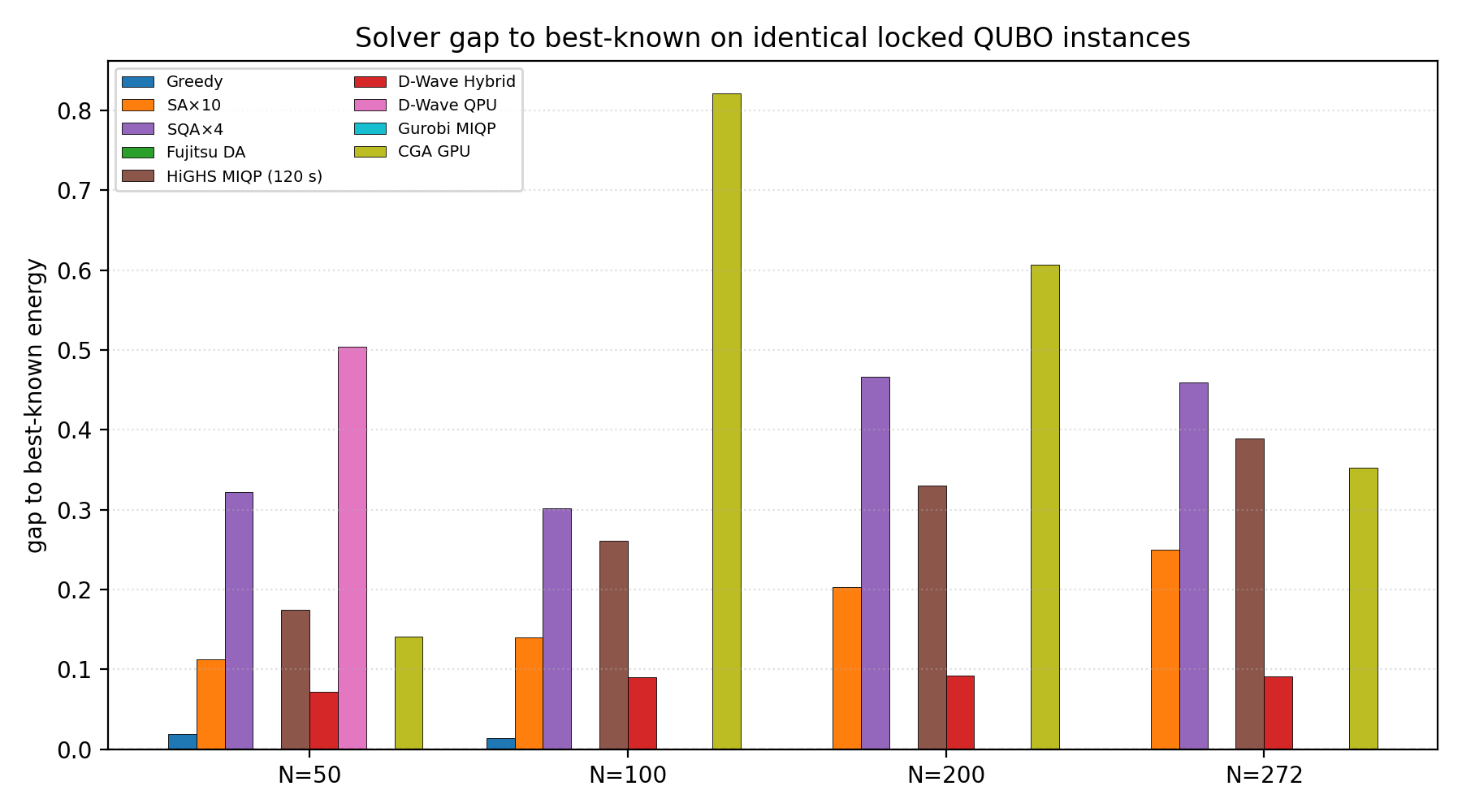
Source data: reports/phase8_solvers_full_canonical.csv
Bar chart of solver gap to best-known energy on identical locked QUBO instances (K=10, beta=1), including CGA GPU annealer.
Reliability
- Runs
- 1
- Median
- 4.770031153763284
- Range
- 4.770031153763284 – 4.770031153763284
Optimality
- Bound
- 0.5073599142524472
- Achieved
- 4.770031153763284
- Gap
- 840.1671318065263%
CGA returns a feasible solution but leaves a large gap to the certified optimum in this strongly coupled, high-selection-fraction regime.
Internal Notes
What worked: The Socket.IO submission and decode pipeline successfully returned feasible selections on all tested locked and hard cells.
What didn't: CGA did not close the gap to Gurobi or D-Wave Hybrid in the hard regime; its objective was comparable to or worse than greedy except on hard_N100K25B5 where it modestly beat greedy.
Next time: Run multiple seeds/repeats per cell, sweep anneal budgets (30/60/120 s), and compare CGA against Fujitsu DA and D-Wave Hybrid under identical time limits.
Reproduce
- Commit
- unknown
- Command
- cd /research/projects/catalyst-hpc-qml && python experiments/26_cga_bench.py